
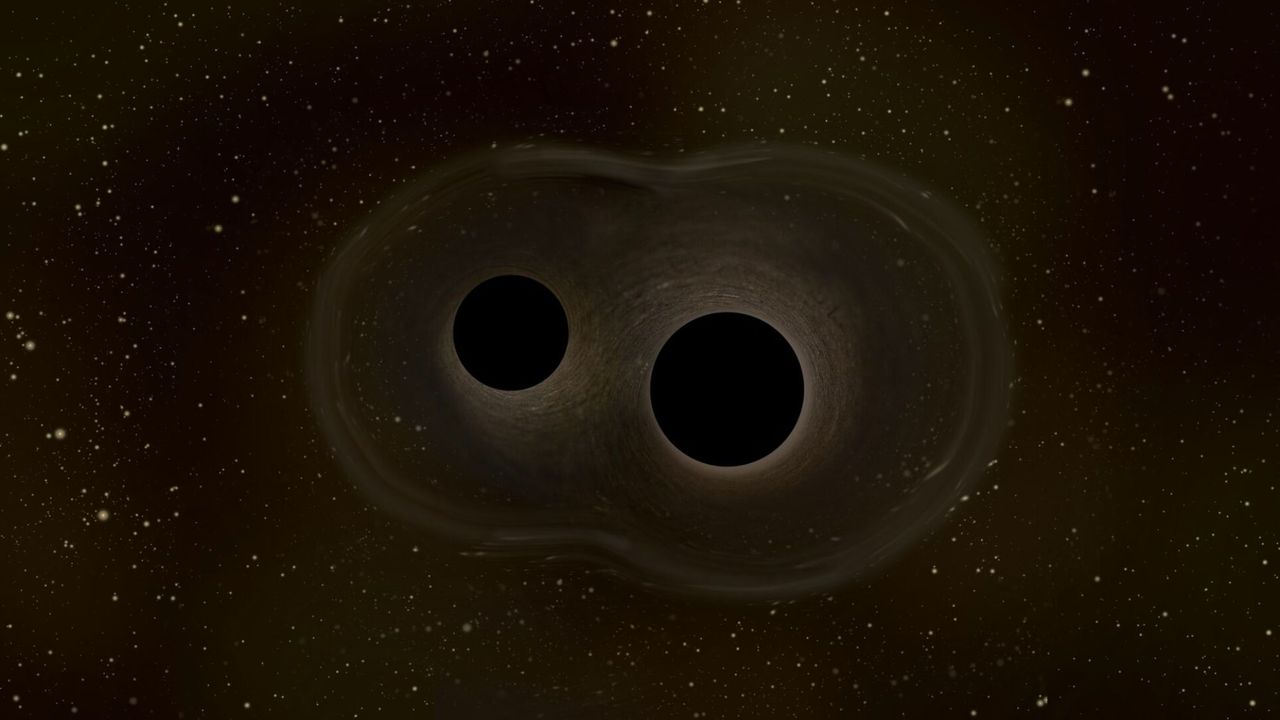
An off-the-shelf camera could help us find more black holes smashing together. "It doesn't require any new technology development, which is almost unheard of for solving a LIGO instrumentation problem."
A apuração publicada por www.space.com vira base para uma leitura editorial direta e contextualizada.
Trechos de apoio da pauta: Fixing a problem inside one of the world's most sophisticated scientific observatories might seem like the kind of challenge that demands a multimillion-dollar upgrade or revolutionary new technology. But for scientists working on the Laser Interferometer Gravitational-Wave Observatory (LIGO), which listens for ripples in spacetime generated by cosmic collisions like merging black holes, the solution to a mild but persistent engineering challenge turns out to be as simple as an off-the-shelf camera.By pairing commercially available thermal imaging cameras with computer models, a team led by Jonathan Richardson at the University of California, Riverside, has developed a technique that corrects tiny, heat-induced distortions in the observatory's mirrors — an elusive flaw that scientists say currently limits how far into deep space the facility can look."It doesn't require any new technology development, which is almost unheard of for solving a LIGO instrumentation problem," Richardson said in a statement.Once incorporated into LIGO's upcoming upgrade, Richardson and his team estimate the fix would extend the observatory's reach by roughly 33 million light-years.That gain might sound like a drop in the ocean against the unimaginably vast scale of the universe, but because space expands in three dimensions, pushing a detector's reach even slightly opens up an exponentially larger window of space.
- Ponto de atenção: shelf.
- Ponto de atenção: camera.
- Ponto de atenção: could.
Em resumo, a leitura editorial acompanha o impacto do tema no nicho Lifestyle.


:quality(85)/5efcc2a2-59cc-4dba-99f4-bd100c4c1986.jpg)