
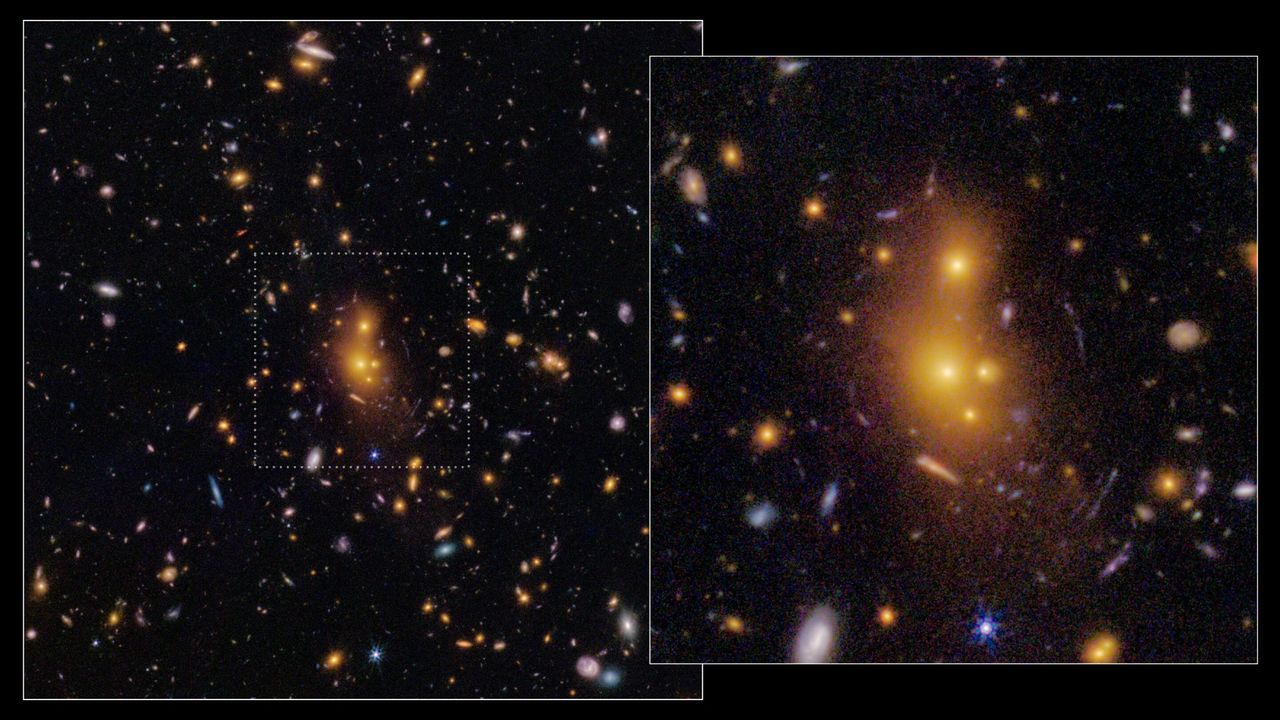
The James Webb Space Telescope peered into one of the universe's oldest galaxy clusters, and scientists can't explain what they saw. Using the James Webb Space Telescope, astronomers have spotted a massive and densely packed galaxy cluster at "cosmic noon" before such structures were thought to be possible.
A apuração publicada por www.space.com vira base para uma leitura editorial direta e contextualizada.
Trechos de apoio da pauta: Using the James Webb Space Telescope, astronomers have spotted a massive and densely packed galaxy cluster at "cosmic noon." The fact that this cluster is so highly evolved could change theories of cosmic evolution, as it seems to exist before such structures were thought to be possible.Designated XLSSC 122 and first seen in 2014, the cluster immediately stood out to the team in James Webb Space Telescope (JWST) data because, being so large and concentrated, it resembled the galactic clusters found much closer to our own galaxy. However, this cluster is seen as it was around 10.4 billion years, just around 3.4 billion years after the Big Bang, a time when such structures were theorized to have only just begun to assemble.Even more excitingly, XLSSC 122 is acting as a gravitational lens and is aligned with even more distant galaxies, amplifying their light and making them easier to study."When we got those first images back from JWST, we said, 'wow, look at this, there's strong lensing coming from this cluster!' XLSSC 122 has now set the record for the most distant galaxy cluster displaying strong lensing, which is a valuable tool for astronomers," team leader Kyle Finner of the California Institute of Technology said in a statement.What is gravitational lensing and why is it so useful?Gravitational lensing was first predicted by Albert Einstein in his 1915 theory of gravity, known as general relativity.
- Ponto de atenção: james.
- Ponto de atenção: webb.
- Ponto de atenção: space.
Em resumo, a leitura editorial acompanha o impacto do tema no nicho Lifestyle.


