🌊 Negócios em Emersão  ·  Vamos Emergir?  ·  Cadastre-se e ganhe 50 REC de bônus
Notícias

Acompanhe as Notícias da Recifes

Fique por dentro das últimas novidades sobre tecnologia, negócios e empreendedorismo.

19 notícias encontradas para "physicists"
Foto: Daigoro Folz / Pexels
An orbiting disco ball gave Einstein’s theory its most precise test yet
The Earth may not be that massive, but it still distorts space-time. O recorte ajuda a contextualizar a pauta dentro de Tech.
Random wobbles in time could finally solve gravity’s greatest mystery
The question of how gravity interacts with the quantum world has long perplexed physicists, but a non-quantum theory of space-time could present an answer
The strange metals forcing us to rethink how electricity really works
Some 40 years ago, physicists noticed certain metals were conducting electricity in a bizarre way no one could explain. New answers to how and why this happens are forcing us to question how electricity flows
Geometric anti-spring works near absolute zero, suppressing vibrations below 0.185 hertz
Physicists and instrument makers in Leiden have succeeded in optimizing a spring that almost completely filters out vibrations at temperatures near absolute zero. This breakthrough opens the door to a new generation of highly sensitive experiments. The research is published in th
Semiconductor quantum dots 'reawaken' predicted Rabi oscillations, boosting quantum contro
Physicists at Paderborn University have, for the first time, experimentally demonstrated the so-called "return" of Rabi oscillations in semiconductor quantum dots. The phenomenon, which was first predicted theoretically in 2007, describes the decrease in the emission intensity of
Physicists demonstrate Hong–Ou–Mandel interference with more than 10 atoms
In a new study published in Nature Physics, researchers have demonstrated the Hong–Ou–Mandel (HOM) effect with up to 12 indistinguishable neutral atoms—an effect that has been predominantly observed in photonic systems.
Quantum computer simulates hadronization, reproducing string breaking with 104 qubits
By remotely accessing an IBM quantum computer, a research scientist at Lawrence Berkeley National Laboratory has successfully simulated a key process in particle physics: hadronization. Although based on a simplified model of quantum mechanics, the project lays the groundwork for
Physicists and AI model Claude 'collaborate' to prove a 10-year-old jamming conjecture
A mathematical problem that had remained unsolved for more than 10 years in the physics of complex systems has finally been resolved through an unusual collaboration: one involving two theoretical physicists and an artificial intelligence system. In a study published in the Journ
Quantum semiconductor design could expand search for dark matter
Dark matter accounts for 85% of the matter in the universe, but scientists still do not know what it is made of. A study, published in Physical Review Letters, by Rice University researchers proposes a detector design that could help search for axions, hypothetical particles that
Foto: Adis Resic / Pexels
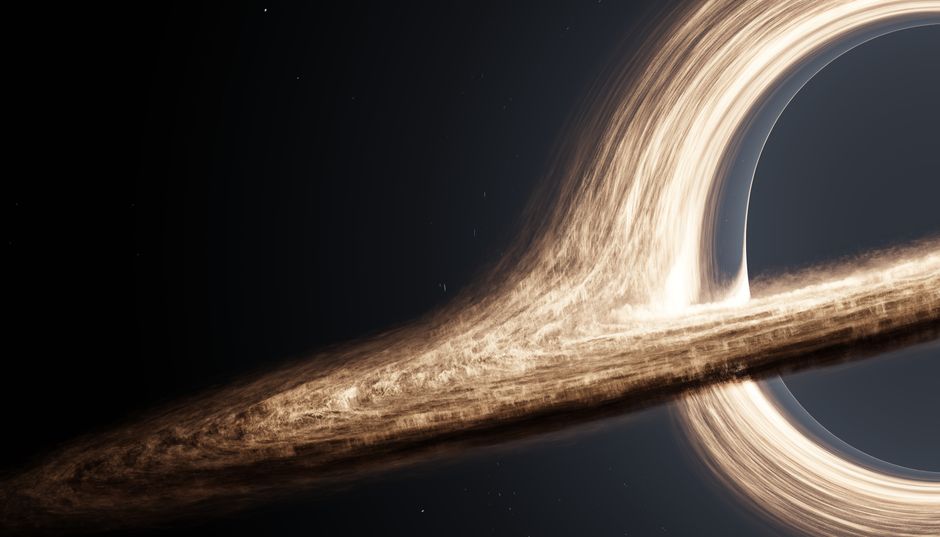
Dynamic black holes may obey Hawking-style thermodynamics with an alternative entropy meas
Of the known things in the universe, black holes are among the most extreme. They pack huge amounts of mass densely into a small area, producing gravity that is so strong that even light cannot escape. To describe their properties, physicists have relied on complex equations from
Metallic rutile oxides break the rules of cooling
Physicists have long puzzled over a strange contradiction inside a family of minerals called rutile oxides. These materials all share the same crystal structure—but while some of them, like titanium dioxide, are firmly insulating, others, like ruthenium dioxide, conduct electrici
Tiny carbon rings enable a new form of quantum control
Quantum states can be precisely controlled with the help of tiny carbon rings measuring only a few nanometers in size. This is made possible by a class of rarely used electromagnetic dipoles called toroidal moments. Using computer simulations, physicists at Martin Luther Universi