🌊 Negócios em Emersão  ·  Vamos Emergir?  ·  Cadastre-se e ganhe 50 REC de bônus
Notícias

Acompanhe as Notícias da Recifes

Fique por dentro das últimas novidades sobre tecnologia, negócios e empreendedorismo.

28 notícias encontradas para "objects"
NASA Space Telescope Maps Magnetic Fields of ‘Lighthouse’ Pulsar
For the first time, scientists have used NASA’s IXPE (Imaging X-ray Polarimetry Explorer) to directly measure the magnetic fields of PSR J1101−6101, a pulsar located within what is often referred to as the Lighthouse Nebula. The results provide new insight into the structure of s
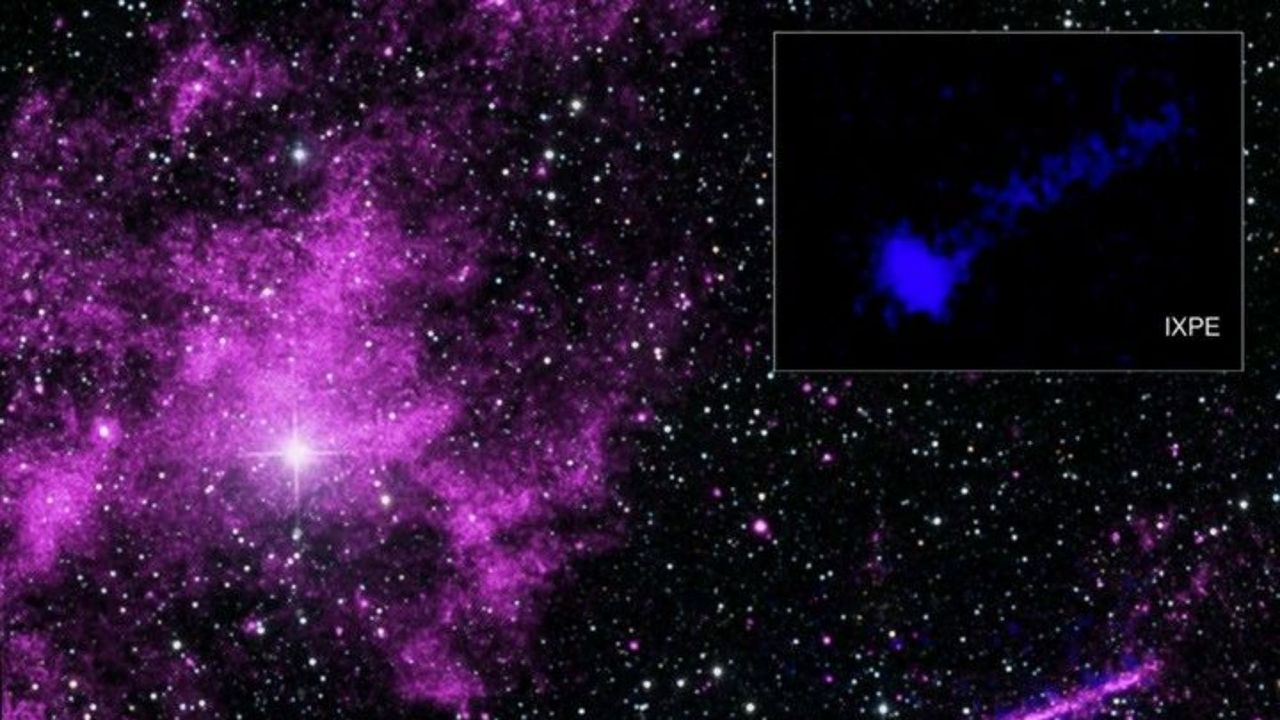
This cosmic 'lighthouse' is blazing a magnetic trail through the Milky Way
For the first time, astronomers have directly mapped the magnetic field surrounding one of the Milky Way's most unusual pulsars, confirming a decades-old prediction about how particles stream away from the rapidly spinning stellar corpse.
Foto: Nicola Narracci / Pexels
A thermodynamic approach to gravity could explain cosmic acceleration without dark energy
Gravity, the force that attracts objects toward each other, is currently framed by Albert Einstein's theory of general relativity. This framework describes gravity as the curvature of spacetime, the invisible four-dimensional fabric of the universe.
What are supermassive black holes? Everything you need to know about these mysterious obje
Nearly every massive galaxy observed hosts a supermassive black hole at its center. NASA's James Webb Space Telescope has discovered that some of these supermassive black holes may even be too big for the galaxy they're found in, challenging astronomers' understanding of these ob
Ancient stellar flyby may still be steering long-period comets today
The Gaia mission has allowed researchers to understand the motions of stars like never before, even revealing possible interactions between our solar system and nearby stars. Planetary Science Institute Senior Scientist Nathan Kaib and collaborator Sean Raymond (Universite de Bor
Foto: Zelch Csaba / Pexels
Uranus, Neptune may be magma worlds, not ice giants
Uranus and Neptune remain two of the most mysterious objects in the solar system, primarily because they have been visited only by NASA's Voyager 2 spacecraft in 1986 and 1989, respectively. Their "ice giant" moniker comes from longstanding hypotheses that their interiors are com
A cataclysmic collision in space provides new clues on astronomy's biggest stalemate
Second only to black holes, neutron stars—incredibly dense star remnants—are the densest objects in the universe. When neutron stars collide, they create ripples in the fabric of space and time that we can detect on Earth.
Astronomers find an enigmatic source that is most likely a Little Red Dot in formation
Astronomers have, for the first time, found a source in the process of becoming a Little Red Dot, using the James Webb Space Telescope (JWST). Little Red Dots are likely early galaxies and some of the most intriguing objects found with JWST at high redshifts. The team, led by Kar
Foto: Google DeepMind / Pexels
Schrödinger’s anthill: Quantum entanglement found in a crystal large enough to hold
A centimeter-sized crystal has revealed clear signs of quantum entanglement, showing that large, everyday objects can display surprisingly deep quantum behavior. The discovery could help solve the mystery of strange metals while opening new possibilities for ultra-precise quantum
These ancient quasars shouldn't exist so soon after the Big Bang
Astronomers have uncovered 31 of the oldest known quasars, including the two earliest ever detected, shining from a time when the universe was only about 670 million years old. Powered by supermassive black holes billions of times the Sun’s mass, these incredibly bright objects c
New technique takes the heat out of 3D printing process
Researchers have developed a new 3D printing technique that allows the printing of whole objects while controlling the temperature of the chemical reaction to stabilize the process. Academics in the University of Nottingham's Faculty of Engineering, in collaboration with the Univ
Capturing the cosmic 'drift' before a star is born
Stars like our sun are formed from the collapse of stellar objects called prestellar cores, cold and dense concentrations of gas and dust held together by gravity. While many questions remain about the exact mechanisms of star formation, advanced radio telescopes have given resea