🌊 Negócios em Emersão  ·  Vamos Emergir?  ·  Cadastre-se e ganhe 50 REC de bônus
Notícias

Acompanhe as Notícias da Recifes

Fique por dentro das últimas novidades sobre tecnologia, negócios e empreendedorismo.

571 notícias encontradas para "astro"
How NASA taught four astronauts to read the moon
How do you teach someone to look at the moon? Not glance at it, the way we all have on a clear night, but truly read it, the way a geologist reads a hillside. That was the challenge NASA set itself before Artemis II, because when Reid Wiseman, Victor Glover, Christina Koch and Je
Astronomers found two rare super puff planets lighter than cotton candy
Two newly confirmed "super-puff" planets are so diffuse that they are less dense than cotton candy, despite being about the size of Jupiter. Their rare orbital relationship and enormous, lightweight atmospheres could provide valuable clues about how some of the strangest planets
New millisecond pulsar discovered with the Murchison Widefield Array
Using the Murchison Widefield Array (MWA), astronomers have discovered a new millisecond pulsar as part of the ongoing Southern-sky MWA Rapid Two-metre (SMART) survey. The discovery is reported in a research paper published June 17 on the arXiv preprint server. The work has also
Off-center stellar death points to wandering supermassive black hole stripped of its own g
Astronomers have uncovered new details about the black hole that ripped apart a star in a tidal disruption event named AT2024tvd. Findings suggest it is a wandering supermassive black hole—the kind that is not located at the center of a visible galaxy. The paper outlining this re
Foto: Jonathan Borba / Pexels
Reanalysis suggests 'Phoebe' is a variable star, not a primordial black hole
A new study debunks a recent claim that astronomers may have detected a lunar-mass primordial black hole. In a reanalysis of observations from the Dark Energy Camera (DECam), researchers found that the star nicknamed "Phoebe" was simply doing something ordinary that many stars do
Foto: Jason Pittman / Pexels
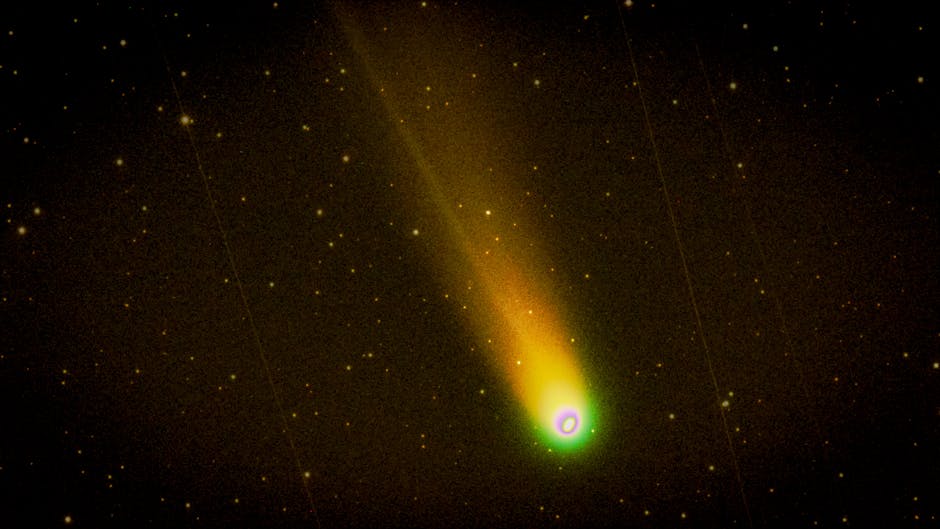
12 billion years old, this interstellar comet is older than our solar system
One year ago, on July 1, 2025, astronomers discovered a fascinating new object moving through the solar system. Detected by the Asteroid Terrestrial-impact Last Alert System (ATLAS), the object was quickly recognized as something special.
Foto: Dua'a Al-Amad / Pexels
Nova V612 Scuti's light curve becomes audio, revealing how stellar shocks evolved
Researchers in the Department of Physics & Astronomy at Texas Tech University recently used audio to represent the spectacular explosion of a star in deep space while also delving into the data to better understand how the phenomenon unfolded.
Foto: GURYAN / Pexels
New Horizons tracks solar wind slowdown as interstellar atoms add drag
A new Southwest Research Institute (SwRI) study based on data from NASA's New Horizons spacecraft has uncovered insights into why the solar wind gradually slows as it moves toward the edge of the solar system and the boundary with interstellar space. The study "The Gradual Slowin
One of the most distant 'leaky' galaxies ever found may reveal how the universe reionized
Astronomers have identified one of the most distant candidate galaxies known to leak ionizing radiation—the same kind of radiation thought to have transformed the early universe during the epoch of reionization.
Open cluster NGC 6134 in Norma is 1.38 billion years old and hosts a core, tidal tail and
Indonesian astronomers have conducted a comprehensive study of an open cluster in the constellation Norma, known as NGC 6134. Results of the new study, available in a research paper published June 23 on the preprint server arXiv, deliver important insights into the properties and
Foto: Nathanael Schmer / Pexels
Nearby 'Super Earth' may be a better candidate for life than previously thought
Using the Hobby-Eberly Telescope at McDonald Observatory, astronomers have taken a closer look at a nearby exoplanet and discovered it may be more Earth-like than previously thought. The planet, known as GJ 3378b, orbits a small, cool star called a red dwarf. Just 25 light-years
A cataclysmic collision in space provides new clues on astronomy's biggest stalemate
Second only to black holes, neutron stars—incredibly dense star remnants—are the densest objects in the universe. When neutron stars collide, they create ripples in the fabric of space and time that we can detect on Earth.