🌊 Negócios em Emersão  ·  Vamos Emergir?  ·  Cadastre-se e ganhe 50 REC de bônus
Notícias

Acompanhe as Notícias da Recifes

Fique por dentro das últimas novidades sobre tecnologia, negócios e empreendedorismo.

18 notícias encontradas para "gravitational"
Black hole's 'point of no escape' studied with the loudest gravitational waves ever heard
The loudest crash of gravitational waves ever heard provides an intriguing way of studying event horizons, the boundaries at which nothing can escape the grip of these cosmic titans.
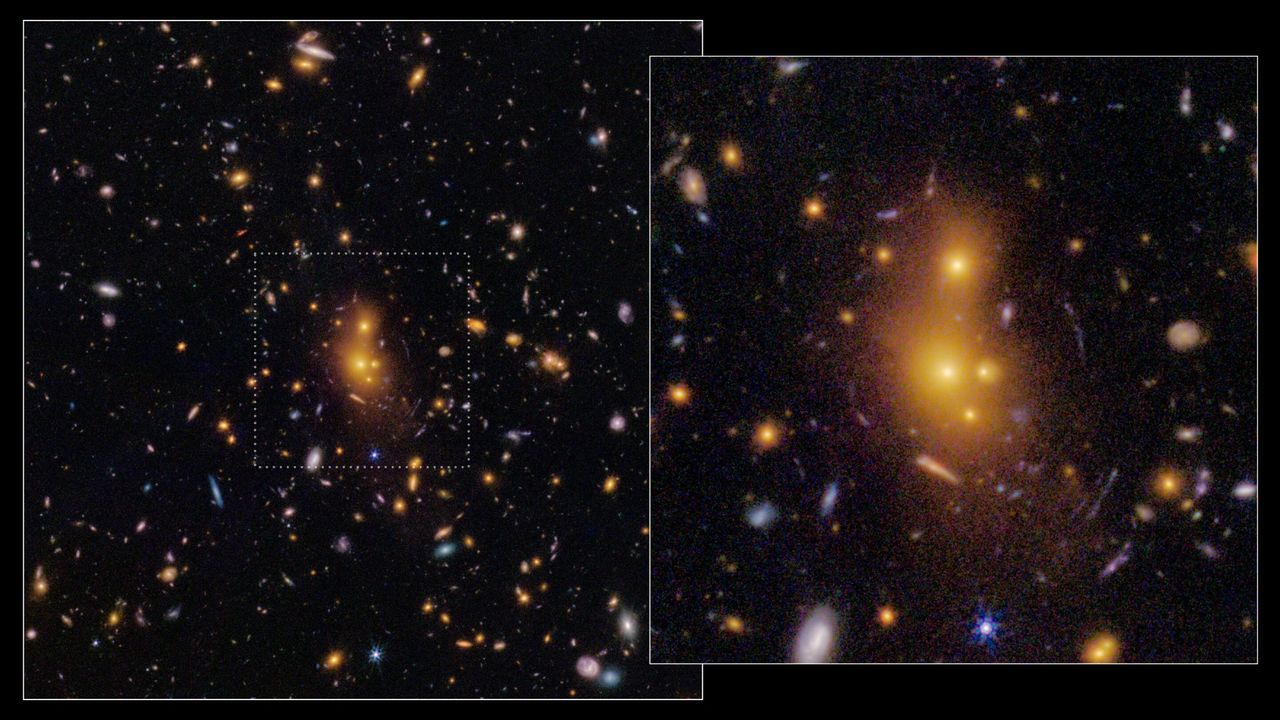
The James Webb Space Telescope peered into one of the universe's oldest galaxy clusters, a
Using the James Webb Space Telescope, astronomers have spotted a massive and densely packed galaxy cluster at "cosmic noon" before such structures were thought to be possible.
NASA just found a planet 'hiding' in TESS spacecraft data, all thanks to Einstein
NASA's exoplanet-hunting spacecraft TESS has a new method for detecting worlds beyond the solar system, and it is thanks to Einstein.
Hubble Captures Star-Studded Cluster
This image from NASA’s Hubble Space Telescope showcases Messier 3 (M3), one of the Milky Way galaxy’s most massive globular clusters, or spherical collections of gravitationally bound stars. Globular clusters are made up of ancient stars that formed at roughly the same time from
Binary black hole signal probes event horizon region for first time
If, in space, no one can hear you scream, it seems that you can actually hear the sound of a crash when two black holes collide. Using the loudest gravitational wave ever heard, two Australian scientists and colleagues have been the first to witness the previously elusive "event
Did gravitational tides cause Earth's extinctions?
Life on Earth took a long evolutionary journey that eventually created us, the purportedly intelligent species that dominates the planet. But there was no grand plan or design, only happenstance, nature and luck. Life on Earth suffered multiple extinctions, but got up, dusted its
Chemically primitive galaxy from 13 billion years ago reveals record-low oxygen
An international team of astronomers has used the James Webb Space Telescope (JWST) and a natural phenomenon known as gravitational lensing to achieve a definitive characterization of LAP1-B, an ultra-faint galaxy from 13 billion years ago. Expanding upon initial detections, this
The solar gravitational lens could map white dwarfs and black holes
It feels like every few months we get to report on another academic paper singing the praises of the Solar Gravitational Lens (SGL). Partly, this is due to Dr. Slava Turyshev's astounding productivity in pumping out academic articles, but partly because such a groundbreaking miss
390 gravitational wave detections reveal hidden population of black holes
Astronomers have released the largest gravitational wave catalog ever, revealing 161 new black hole collisions and pushing the total number of detections to 390. Among the highlights are the clearest gravitational wave signal ever recorded, the most accurate location of a black h
Foto: Zelch Csaba / Pexels
A strange LIGO signal could reveal the missing link behind dark matter
An unusual gravitational wave signal has renewed hopes that primordial black holes, long considered purely theoretical, may finally be within reach of discovery. If confirmed, they could solve one of astronomy's greatest mysteries by explaining the nature of dark matter.
NASA's Hubble spots star-spangled cosmic scene
More than 500,000 stars blaze red, white, and blue in this image from NASA's Hubble Space Telescope, released in celebration of the United States' 250th anniversary. The image showcases Messier 3 (M3), one of the Milky Way galaxy's most massive globular clusters, or spherical col
Black hole collisions may follow entropy law, offering simpler remnant predictions
When two black holes orbit each other, they eventually spiral inward and collide in one of the most violent phenomena in the universe. The event is so energetic that it significantly distorts the universe around it. It emits gravitational waves—ripples in the fabric of spacetime—